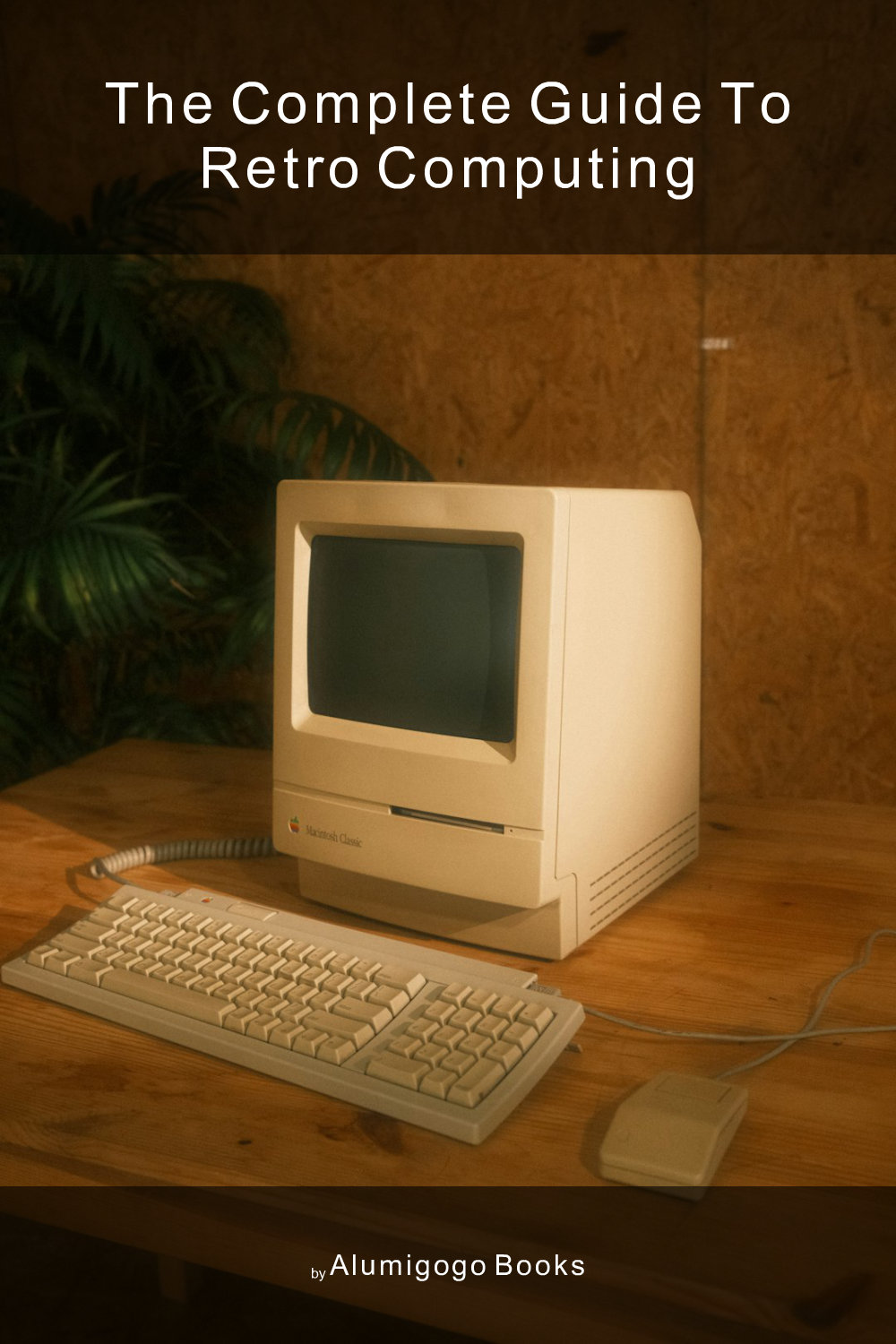
The Complete Guide to Retro Computing
What it really costs, what gear you actually need, and how to know if this hobby is for you before you spend a dime
★★★★★4.0 · 5 reviewsby Alumigogo Books
non-fiction
The Complete Guide to Retro Computing
What it really costs, what gear you actually need, and how to know if this hobby is for you before you spend a dime
★★★★★4.0 · 5 reviewsby Alumigogo Books
non-fiction
Real costs, real gear, real expectations. The honest beginner's guide to retro computing before you buy your first vintage machine.
🔒Secure checkout via Stripe
Labor Day Sale
$9
About this book
You remember the hum of a CRT monitor, the clack of a mechanical keyboard, the thrill of loading a game from a floppy disk. Now you're curious about getting back into that world, but every YouTube video shows someone with three decades of accumulated gear, and every forum thread assumes you already know what an ISA slot is. This guide cuts through all of it.
Written by someone who has spent years collecting, repairing, and actually using vintage computers, this book tells you what it really costs to start, what you can skip at first, and what a typical session actually feels like. You'll learn about the three budget tiers, the honest signs the hobby isn't for you yet, and a week-by-week plan for your first steps. No hype, no gatekeeping, no vague inspiration - just plain talk about a hobby that's equal parts frustrating and magical.
Reader Reviews
David Hill
★★★★★I've been lurking on retro computing forums for months but was too intimidated to buy anything. This book finally gave me actual numbers - real prices for real machines, what I could skip buying at first, and a clear sense of whether this hobby fits my apartment and my schedule. I appreciated that it didn't try to sell me anything. The first-week checklist alone was worth the price. I'm still not 100% sure I'm ready to commit, but now I know exactly what I'd be getting into, and that's more than any YouTube video gave me.
Michael Thompson
★★★★★This is the book I wish I had five years ago when I accidentally bought a dead Commodore 64 at a flea market. The chapter on what a typical session actually looks like is spot-on - the fiddling, the frustration when something doesn't work, and that incredible feeling when you finally get it running. The author writes like a friend who's been there, not a guru trying to impress you. The cost breakdowns are honest and the self-assessment in chapter 2 made me realize why some of my friends quit the hobby. I've already recommended this to three people.
Karen Lopez
★★★★★I bought this because I was nostalgic for my dad's old IBM PC but had zero knowledge about how to start collecting. The practical details won me over - the book tells you which cables are actually hard to find, what a CRT monitor weighs, and how much space you really need (more than you think). It also convinced me to start with emulation before buying real hardware, which saved me from a very expensive mistake. The chapter on first weeks is genuinely actionable. Only reason it's not five stars: I wanted more photos, but the text is so clear I managed anyway.
Jacob Thompson
★★★★★Decent overview of the hobby and the cost breakdown was helpful. However, the author's enthusiasm sometimes gets ahead of the reality - they call the frustrating moments part of the fun, but after reading about how much time can go into just getting a machine to boot, I'm pretty sure this isn't the hobby for me. Which is actually useful to know, so I appreciate the honesty there. The chapter on whether this is right for you was the most valuable part for me. It saved me from spending a few hundred dollars on equipment I'd probably abandon after a month. I'm rating it three stars because it didn't change my mind, but it definitely did its job.
Sandra Anderson
★★★★★Finally a guide that treats me like an adult and not a potential mark for an overpriced starter kit. I appreciated the three budget tiers in chapter 3 - the $100 starting option felt genuinely realistic, and the comparison table made it easy to see what I'd be missing at each level. The typical session narrative was eye-opening because it showed the hobby isn't just playing old games; it's diagnosing problems, learning how these machines actually work, and sometimes just sitting there confused for an hour. That's actually the part I'm most excited about now. The self-assessment checklist felt a little basic, but for a total beginner like me, it was useful.